
Article · Writing charts
How to write chord charts with rhythm notation: hits, pushes and stops
A chord chart that only lists chords leaves the band to guess the rest. Most of the time that's fine: good players comp. But the moments a band plays together (the hits, the push into the chorus, the stop before the last verse) are exactly the moments a guess goes wrong. Here's how to write them so a band reads them at sight.
Updated
When a chart needs rhythm
- Hits (also called kicks or accents): the whole band plays a chord together on specific beats.
- Pushes (anticipations): a chord arrives an eighth or a quarter early, before the bar line.
- Stops: everyone stops for a beat or a bar, often before a section.
- Figures: a riff or groove everyone needs to lock into.
Everywhere else, leave the grid alone. A chart where every bar is notated is harder to read, not easier.
The baseline: a plain chord grid
Most of a chart should be chords in bars with no rhythm written. That tells the band to play time and comp the way
the style asks. A bar with one chord lasts the whole bar; two chords in a bar split it evenly, so
| Gm7 C7 | is two beats each in 4/4.
[A]
| Gm7 | C7 | FM7 | ./. |
| Gm7 C7 | Am7 D7 | Gm7 C7 | F |Slashes and rhythmic notation
On paper, some writers show time with stemless slashes, one per beat. ChordCast doesn't draw those, and doesn't need to: a bar with no lengths already means “play time”. As soon as you give a chord a length, ChordCast writes rhythmic notation, slash noteheads with stems, beams, dots and ties, and that means the band plays exactly that rhythm. So write lengths only where the band should play together, as in the next sections.
Writing hits
For a hit, write the actual rhythm: notes on the beats the band plays, rests between. A dotted quarter and an eighth followed by a half rest is one of the most common hits in pop and funk: “one… and-of-two, rest”.
%TITLE="Rhythm figures"

[Hits]
| F7:4. F7:8 r:2 | Bb7:4. Bb7:8 r:2 |
| F7:8 F7:8 r:4 F7:4 r:4 | C7:2 Bb7:4 F7:4~ | :1 |

[Push and triplets]
| Dm7:2 G7:2 | <:8 CM7:1 |
| Dm7:4_3 Em7:4_3 FM7:4_3 G7:2 | C:1 |Tips for hits a band can read
- Put rhythm only where it matters. A staff appears under a line only when it has rhythm, so a mostly-grid chart stays light.
- Write rests. A hit is as much about the silence after it. Without the rest, players will sustain.
- Tie across the barline instead of writing a long note that crosses it. It shows where the next bar starts.
- Add a word. “Horns”, “Band out”, “Drums only” above the bar says who plays.
Pushes and anticipations
A push is a chord that arrives early, usually an eighth note before the bar. You can write it as an eighth at the end of the previous bar tied into the next, or as a push sign: ChordCast's syncopation draws the chord early and borrows the time from the bar before, which keeps the grid clean.
| Dm7:2 G7:2 | <:8 CM7:1 |Here CM7 lands on the “and” of four in the previous bar.
Stops and N.C.
For a stop, write the hit and rests for the rest of the bar, or N.C. (no chord) for bars where the band drops out and something else carries on. A multi-bar rest says how long.
[Waltz]
| (3/4) Dm | ./. | Gm7 | A7 |

[Out]
| (4/4) Dm7 G7 | -2- | N.C. | Dm:1 ||.How to write rhythms in ChordCast
Tapping: in the visual editor, tap a chord and pick its length under Rhythm: whole to sixteenth, dotted, triplet, tied. Syncopation makes a push, and Rest in the toolbar adds rests.
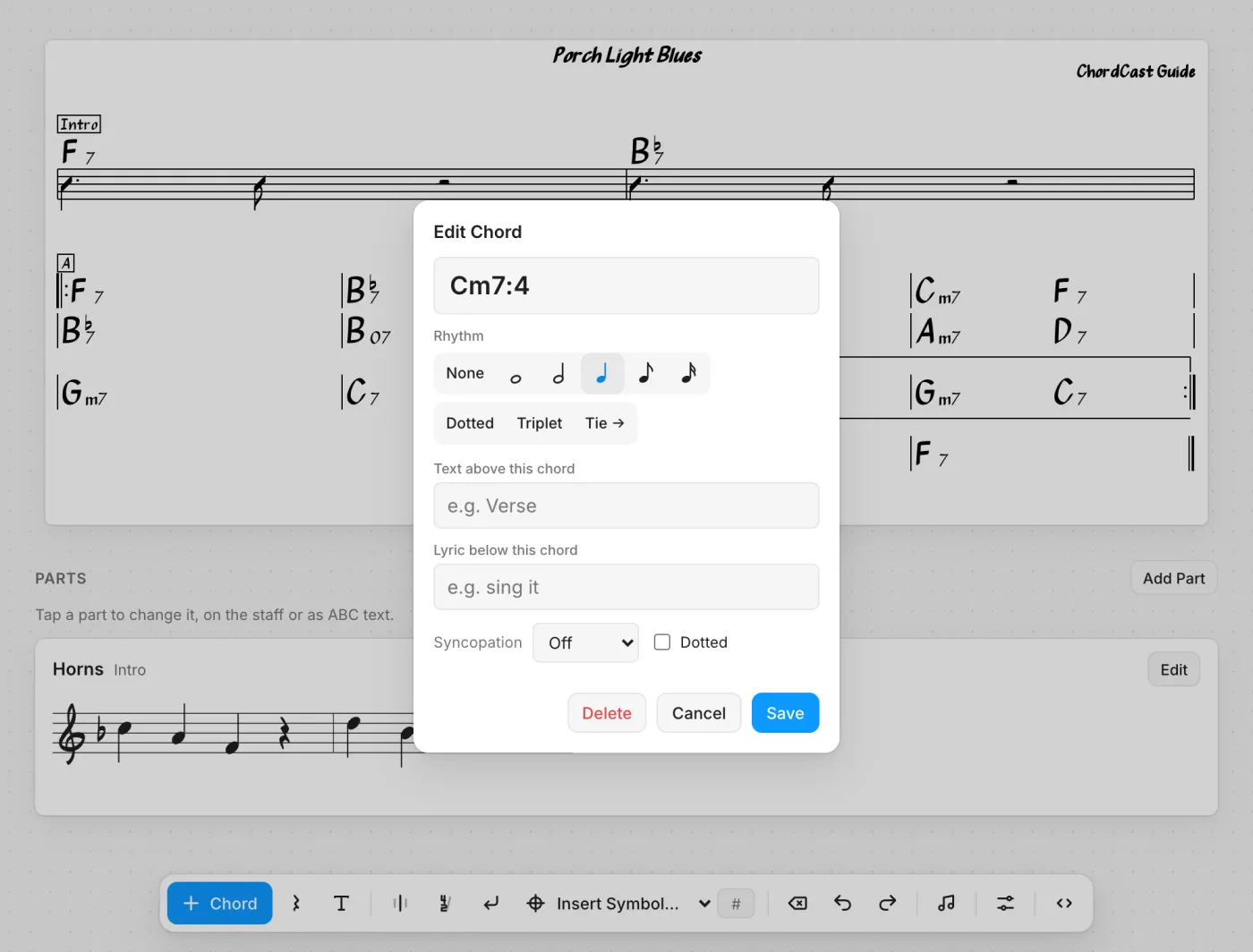
Typing: in the text editor, add a length after a colon.
| Type | For |
|---|---|
C:4 | A quarter note (:1 :2 :8 :16 for the others) |
C:4. | Dotted |
C:4~ :4 | Tied to the next |
:4 | Another note on the same chord, without writing the chord again |
r:2 | A half-note rest |
C:4_3 :4_3 :4_3 | Quarter-note triplets |
<:8 C:1 | A push, an eighth early |
Try it in the interactive editing tutorial, and see the full rhythm reference. For melodies, horn lines and riffs, a chart can also carry melody parts in standard notation.
Questions
Do I have to notate every bar?
No, and you shouldn't. Lines without rhythm stay a plain chord grid with no staff.
Does the rhythm transpose with the chart?
The rhythm stays put; the chords above it move to the new key.
Can I import rhythms from iReal Pro?
iReal Pro charts don't carry written rhythms, so imported charts come in as chord grids. Add the hits after importing.